

solutions@disolutions.net

+91-9904566590


App Development

By DI Solutions
Developer
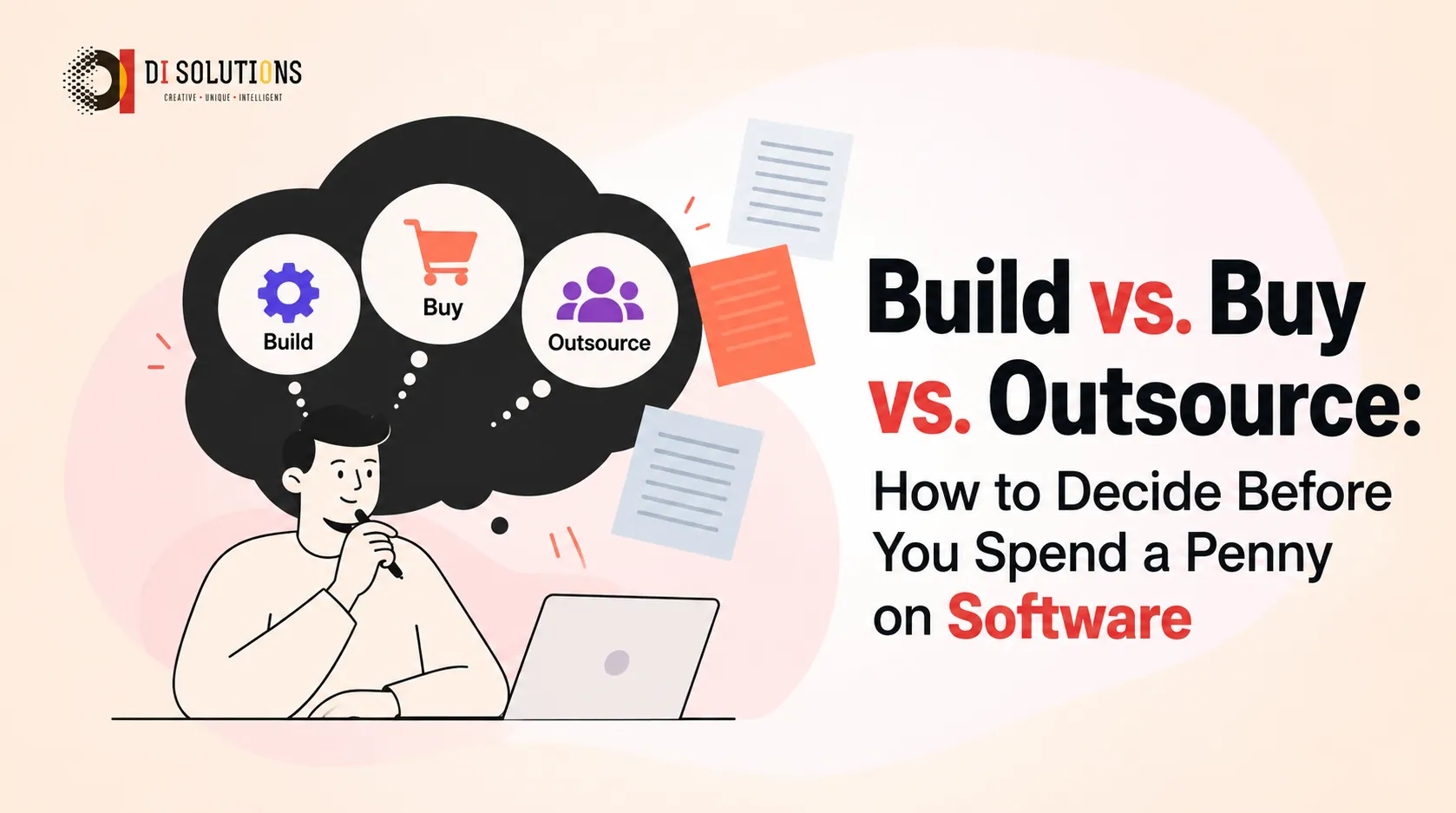
Every software project starts with the same question: should we build it ourselves, buy something ready-made, or hire an outsourcing partner?
Get it right and you launch faster, spend less and stay flexible. Get it wrong and you can lose months and a large part of your budget on a tool that doesn’t fit, or on a team you can’t manage.
This guide gives you a simple framework, a comparison table and a list of red flags so you can decide with confidence.
Many companies also mix these options. For example, they buy a standard tool for accounting and outsource a custom customer portal.
Answer these questions honestly before you compare vendors or post job ads.
If the software is your product, or it supports a process that makes you different from competitors, lean towards build or outsource. If it handles a common need such as payroll, email or basic accounting, buy.
If a SaaS tool already does most of what you need, buying is almost always faster and cheaper. If you would have to bend your whole workflow around it, custom software will pay off sooner than you expect.
Building in-house means recruiting, onboarding, managing and retaining engineers. That takes months before the first line of production code. If you don’t have a technical leader, outsourcing removes that delay.
SaaS looks cheap at first, but per-user fees grow as you grow. Custom software costs more upfront but has no licence fees. Always compare the total cost of ownership (TCO) over several years.
| Factor | Build (In-House) | Buy (Off-the-Shelf) | Outsource |
|---|---|---|---|
| Upfront cost | High (salaries, tools, recruiting) | Low | Medium |
| Long-term cost | High but predictable | Grows with users and add-ons | Medium; scalable up or down |
| Speed to launch | Slow (hiring first) | Fastest | Fast |
| Customisation | Full | Limited | Full |
| Control over roadmap | Full | Vendor decides | High (you set priorities) |
| Technical expertise needed from you | High | Low | Low to medium |
| Scalability of team | Slow to scale | Not applicable | Easy to scale |
| Main risk | Hiring delays, key-person dependency | Vendor lock-in, missing features | Poor vendor choice, communication gaps |
| Best for | Core product companies with strong tech leadership | Standard business needs | Startups and SMEs needing custom software quickly |
Building makes sense when:
Watch out for: long hiring cycles, salary inflation and the risk that one departing engineer takes critical knowledge with them.
Buying makes sense when:
Watch out for: per-seat pricing that balloons, limited APIs, and data that is hard to export if you switch vendors.
Outsourcing makes sense when:
Outsourcing models include:
Before signing with any development partner, confirm:
Yes, and many successful companies do. A common pattern:
Usually yes for the first few years, because you avoid recruitment costs, benefits, equipment and management overhead. The exact savings depend on the location and skills required.
Outsourcing a project usually means paying for a defined deliverable. A dedicated team model gives you engineers who work exclusively on your product, with you directing priorities day to day.
When your need is standard, speed matters most, and an existing product covers most of your requirements without heavy customisation.
Sign an NDA, make sure the contract assigns all IP and source code to you, and work with a partner that has verifiable references.
A focused MVP often takes roughly 2 to 4 months, while larger platforms take longer. A discovery phase gives a realistic estimate for your specific project.
There is no universally “right” answer, only the right answer for your goals, budget, timeline and team. Use the five questions above, compare the total cost over several years, and check every option against the red flags.
🚀 Still unsure which route fits your project?
DI Solutions has delivered 750+ projects across 10+ countries, and our team of 75+ engineers works with startups and enterprises on custom software, dedicated teams and AI-powered products. 👉 Book a free consultation and we’ll help you choose the approach that makes sense before you spend a penny.