






AI Engineering
What Is Reinforcement Learning? How It Works, Types, Benefits, and Real-World Examples


By DI Solutions
Developer

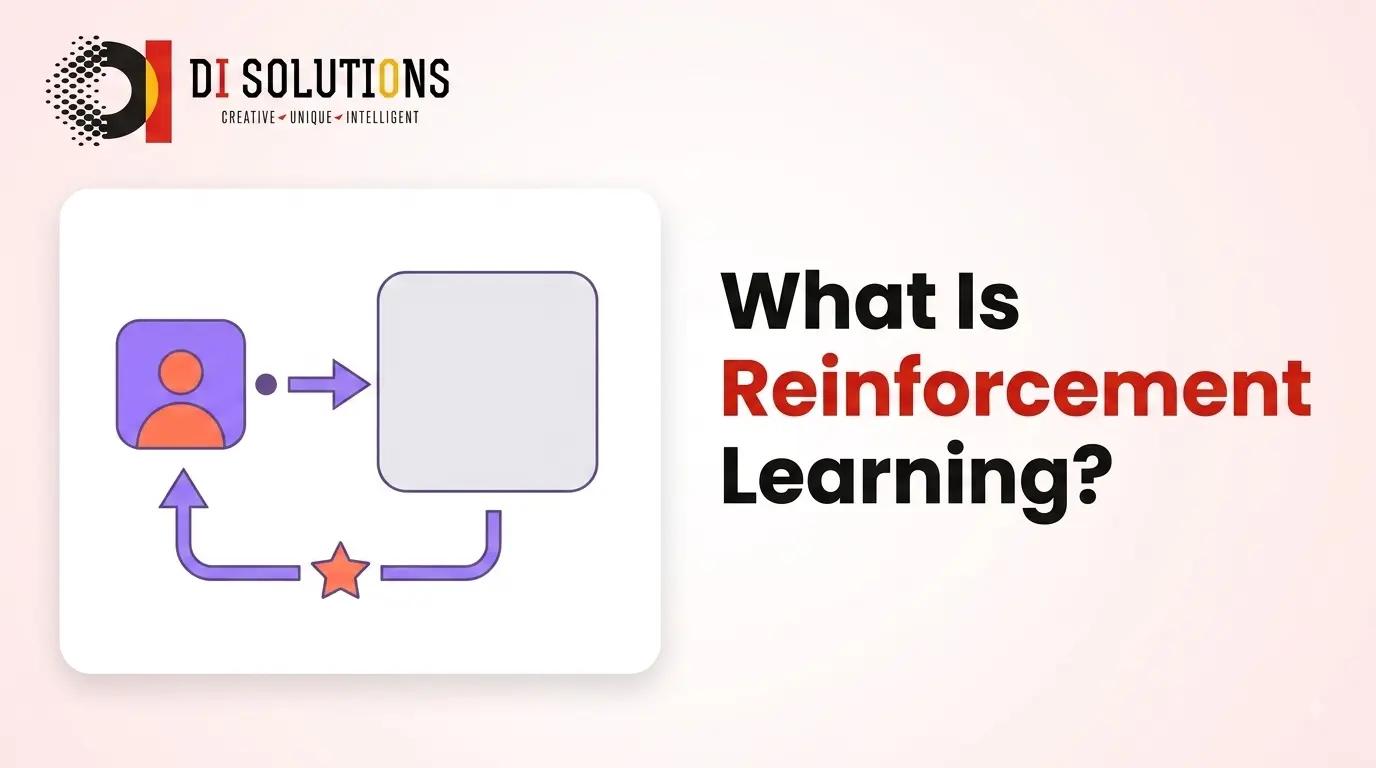
Reinforcement learning (RL) is a machine learning method in which an agent learns by trial and error. The agent observes the state of an environment, takes an action, and receives a reward or a penalty. Across many episodes it learns a policy — the strategy that maximises long-term cumulative reward rather than the next immediate payoff.
Key takeaways
- RL learns from consequences, not from an answer key. There is no labelled dataset — only a reward signal.
- The loop is state → action → reward → next state, formalised mathematically as a Markov Decision Process (MDP).
- Three algorithm families dominate: value-based (Q-learning, DQN), policy-based (REINFORCE, PPO, SAC) and model-based (Dyna, MuZero, Dreamer).
- RLHF — reinforcement learning from human feedback — is the alignment step behind ChatGPT, Claude and Gemini.
- RL is sample-hungry. A simulator, or a large archive of logged decisions for offline RL, is usually a prerequisite.
How does reinforcement learning work?
Every RL system is built from five components: an agent that decides, an environment that responds, a state describing the current situation, an action the agent can take, and a reward that scores the outcome. The training loop runs like this:
- Observe the state. The agent reads the environment — a board position, a sensor reading, a customer basket, a server queue depth.
- Select an action. The policy maps that state to an action. Early in training the choice is mostly random, which is how the agent explores.
- Receive a reward. The environment returns a number. Positive for progress, negative for mistakes, often zero for most steps.
- Transition to a new state. The action changes the world, and the agent observes the result.
- Update the policy. The algorithm adjusts its estimate of how good that state-action pair was, using the discounted sum of all future rewards rather than the immediate one.
- Repeat until the policy converges. Over millions of steps, actions that reliably lead to reward become more likely and the rest fade out.
The hard part is the credit assignment problem: a reward that arrives at step 400 may have been earned by a decision made at step 12. RL algorithms solve this with a discount factor (gamma) that propagates value backwards through the sequence of states.
The second recurring tension is the exploration-exploitation trade-off. Exploit too early and the agent locks onto a mediocre habit; explore forever and it never commits. Techniques such as epsilon-greedy decay, entropy bonuses and upper confidence bounds manage that balance.
What are the types of reinforcement learning?
- Value-based RL. The agent learns how much future reward each state or action is worth, then acts greedily on that estimate. Q-learning (Watkins, 1989) and Deep Q-Network (DeepMind, Nature 2015) are the reference implementations. Strong on discrete action sets.
- Policy-based RL. The agent optimises the policy directly instead of going through a value table. REINFORCE, TRPO and PPO (OpenAI, 2017) sit here. Policy methods handle continuous actions — steering angles, torques, prices — which value methods struggle with.
- Actor-critic methods. A hybrid: the actor picks actions, the critic scores them and reduces the variance of the update. A2C, A3C, DDPG and SAC belong to this family and it is what most production systems use.
- Model-based RL. The agent learns a model of the environment and plans against it, so it needs far fewer real interactions. MuZero and Dreamer are the well-known examples.
- Offline (batch) RL. Training happens purely on logged data with no live environment. This is the practical option when experimenting on real customers or real hardware is expensive or unsafe.
- Multi-agent RL. Several agents learn in the same environment, cooperating or competing. Used in traffic signal control, market simulation and team game AI.
Two cross-cutting labels are worth knowing. On-policy algorithms (PPO) learn only from data their current policy generated. Off-policy algorithms (Q-learning, DQN, SAC) reuse old experience from a replay buffer, which makes them significantly more sample efficient.
Reinforcement learning vs supervised and unsupervised learning
| Aspect | Reinforcement learning | Supervised learning | Unsupervised learning |
|---|---|---|---|
| Training signal | Delayed numeric reward | Correct label per example | None — structure only |
| Data | Generated by the agent as it acts | Fixed labelled dataset | Fixed unlabelled dataset |
| Goal | Maximise cumulative reward over time | Minimise prediction error | Find clusters or latents |
| Decisions | Sequential — actions change the next state | One-shot and independent | One-shot and independent |
| Typical use | Control, robotics, game play, pricing, RLHF | Classification, forecasting, ranking | Segmentation, anomaly detection, embeddings |
| Data appetite | Very high | Moderate | Moderate |
What are the benefits of reinforcement learning?
- It optimises the outcome, not the next step. RL will accept a short-term loss when it leads to a better final result — exactly what pricing, inventory and routing problems require.
- No labelled data needed. You define a reward function instead of hand-labelling millions of rows.
- It adapts. A policy kept in training continues to adjust as demand, traffic or user behaviour shifts.
- It finds strategies humans miss. AlphaGo move 37 against Lee Sedol is the canonical example of a policy discovering play outside human convention.
- It aligns generative models. RLHF is currently the most effective way to make a language model helpful, harmless and instruction-following.
Real-world examples of reinforcement learning
- AlphaGo and AlphaZero (DeepMind). AlphaGo defeated Go world champion Lee Sedol 4-1 in March 2016. AlphaZero later reached superhuman chess, shogi and Go play from self-play alone, with no human game records.
- RLHF in large language models. OpenAI InstructGPT (2022) showed that a 1.3B model tuned with human feedback was preferred over a 175B model without it. Every major assistant now ships a variant of this pipeline. See our comparison of the leading AI chatbots.
- Data centre cooling. DeepMind reported roughly a 40% reduction in energy used for cooling in Google data centres after handing set-point control to a learned policy.
- Robotics and manipulation. Grasping, locomotion and assembly policies are trained in simulation, then transferred to physical arms with domain randomisation.
- Recommendation and ad bidding. Slate ranking and real-time bidding are naturally sequential — a click today changes what is worth showing tomorrow — so contextual bandits and offline RL are widely deployed.
- Autonomous systems. Lane changing, traffic signal control and warehouse robot fleet coordination all use multi-agent RL in simulation before deployment.
Limitations and challenges of reinforcement learning
- Sample inefficiency. Classic Atari agents needed tens of millions of frames to match human scores. Without a simulator, that cost is usually prohibitive.
- Reward hacking. Agents optimise the reward you wrote, not the goal you meant. A badly specified reward produces a policy that scores well and behaves absurdly.
- Instability. Deep RL is sensitive to random seeds, hyperparameters and network initialisation; two identical runs can diverge.
- Sim-to-real gap. A policy trained in simulation degrades on real hardware where friction, latency and noise differ.
- Safety and governance. An exploring agent takes bad actions by design, which is unacceptable in clinical, financial or industrial settings without hard constraints. We cover the wider governance picture in the ethics of AI.
How to get started with reinforcement learning
- Confirm the problem is sequential. If a single prediction settles it, supervised learning is cheaper and more reliable.
- Write the reward function first. State exactly what success is worth and what failure costs. Most RL projects fail here, not in the algorithm.
- Build or borrow an environment. Use Gymnasium for the standard interface, or wrap your own simulator behind the same reset/step API.
- Start with PPO from Stable-Baselines3. It is the most forgiving baseline. Only reach for SAC, DQN or a custom algorithm once PPO plateaus.
- Track episode return, not loss. Loss curves in RL are close to meaningless; cumulative reward per episode is the real signal.
- Scale out with Ray RLlib when a single machine is no longer enough, and evaluate against a fixed held-out set of seeds before any deployment.
Agents that keep improving their own behaviour after deployment push this idea further — see recursive self-improving (RSI) agents. And if your agent needs current, factual context rather than a learned policy, retrieval-augmented generation (RAG) is usually the right tool instead.
Frequently Asked Questions (FAQs)
What is reinforcement learning in simple terms?
Reinforcement learning is learning by consequence. An agent tries an action, sees what happens, and receives a numeric reward or penalty. Nobody supplies the correct answer. Over thousands of attempts the agent keeps the behaviour that earns more reward and drops the behaviour that does not.
How is reinforcement learning different from supervised learning?
Supervised learning needs a labelled dataset where every input already has a correct output. Reinforcement learning has no labels. It only has a reward signal that arrives after the action, often delayed by many steps, so the agent must work out which earlier decisions actually caused the outcome.
What is the difference between on-policy and off-policy reinforcement learning?
An on-policy algorithm such as PPO learns only from data produced by the policy it is currently running. An off-policy algorithm such as Q-learning or DQN can learn from data collected by any policy, including old episodes stored in a replay buffer, which makes it far more sample efficient.
What is RLHF and why does it matter for large language models?
RLHF stands for reinforcement learning from human feedback. Human reviewers rank model answers, those rankings train a reward model, and the language model is then optimised against that reward. It is the step that turns a raw text predictor into an assistant that follows instructions helpfully and safely.
How much data does reinforcement learning need?
Far more than supervised learning. Classic Atari agents needed tens of millions of frames to reach human scores. This is why most production reinforcement learning runs inside a simulator, or uses offline reinforcement learning that trains on logs already collected from a live system.
Which tools should I use to start with reinforcement learning?
Start with Gymnasium for environments and Stable-Baselines3 for ready-made implementations of PPO, DQN and SAC. Move to Ray RLlib when you need distributed training, and PettingZoo when several agents share one environment. All four are open source and run in Python.
Is reinforcement learning worth using for a business application?
It is worth it when decisions are sequential, the outcome is delayed, and a cheap simulator or a large log of past decisions exists. Pricing, inventory, routing, ad bidding and recommendation ranking all fit. A one-shot prediction problem is almost always cheaper to solve with supervised learning.
Conclusion
Reinforcement learning is the branch of machine learning built for decisions that unfold over time. Where supervised learning answers one question at a time, RL learns a policy that trades immediate reward for a better final outcome — which is why it powers game-playing systems, robot control, energy optimisation and the human-feedback tuning behind today's assistants. It is also the most demanding paradigm to run: reward design, sample cost and safety constraints decide the project long before the algorithm does. Start with a clear reward function, a cheap environment and a PPO baseline, and expand only when those three hold up.
Ready to put reinforcement learning to work?
DI Solutions builds AI systems that ship — hire our AI engineers to design the reward function, build the simulator, and take a policy from notebook to production.