



Cost-Efficient Development
One codebase for multiple platforms reduces development and testing cost compared to building separate native apps. Custom hybrid app development services help you get to market within budget.




Build Practical, Scalable, and User-Focused Apps That Work Everywhere

Hybrid app development lets you build one codebase that runs on Android, iOS, tablets, and often web. That means lower cost and faster delivery than maintaining separate native apps, without sacrificing a consistent user experience. Our hybrid mobile app development services are built around your business goals: we align on requirements first, then deliver strong performance and a stable, supportable product.
We focus on long-term scalability and stability. The apps we build use proven frameworks and clean architecture so they perform well under load and are easier to maintain as platforms evolve. Whether you are an enterprise or a startup, our hybrid app developers deliver practical, user-focused apps that work everywhere and grow with you.
Hybrid app development builds apps using web technologies—HTML, CSS, and JavaScript—that run inside a native container (such as a WebView or a bridge layer). The container provides access to device capabilities (camera, GPS, storage, push notifications) through plugins or native modules. One codebase can target multiple platforms, so you maintain a single app that works on Android, iOS, and optionally web.
Popular frameworks and tools we use include Flutter, React Native (often used in react native hybrid app development), Ionic, Apache Cordova, Xamarin, plus backend and integration tools such as Node.js, Firebase, and REST APIs. The right stack depends on your team skills, performance needs, and timeline; we help you choose.
Hybrid app development typically offers lower cost and faster delivery because one codebase serves multiple platforms; native development uses platform-specific languages for maximum performance and platform fit. Hybrid apps can achieve strong performance and scalability for most business and consumer use cases; native can be better for very performance-sensitive or hardware-intensive apps (e.g., high-end gaming). The choice depends on your priorities around cost, speed, performance, and scalability. We provide clear guidance so you can decide with confidence.
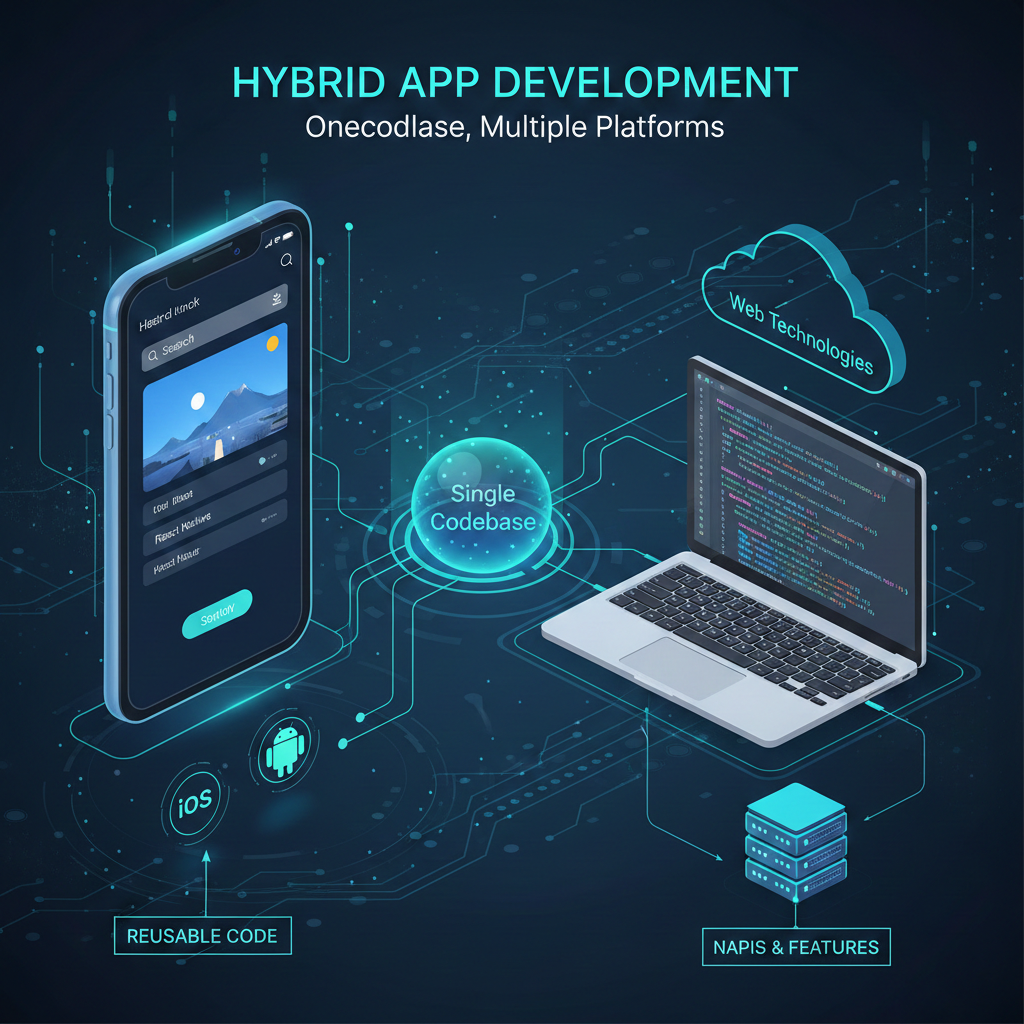
One codebase, multiple platforms—deliver faster and scale with confidence.
One codebase for multiple platforms reduces development and testing cost compared to building separate native apps. Custom hybrid app development services help you get to market within budget.
Shared code and a single release cycle mean you can launch on iOS and Android sooner. Updates and new features roll out to all platforms at once.
Your app runs on Android, iOS, tablets, and often web with one codebase. Users get a consistent experience regardless of device.
One codebase means one set of bugs to fix and one release pipeline. Maintenance and updates are simpler and more cost-effective over time.
Enterprise hybrid app development can scale with your user base and feature set. We use clean architecture and scalable backends so your app grows without rewrites.
Modern hybrid frameworks deliver near-native performance for most use cases. We optimize for speed and responsiveness so your app feels fast and reliable.
We integrate AI where it adds value: recommendations, smart search, chatbots, or personalized content. Users get a more relevant experience without platform lock-in.
Analytics and reporting are built in so you can track usage, funnels, and business metrics. Data-driven insights help you improve the product and prioritize features.
We use monitoring and analytics to detect performance issues and optimize load times, responsiveness, and stability. Proactive tuning keeps your app fast as it grows.
We follow a structured, step-by-step process so your hybrid app is built on clear requirements and delivered with quality.
We align on your business goals, target users, core features, and success metrics so the hybrid app is built on clear requirements.
We choose the right framework (Ionic, React Native, Flutter, or others), define architecture, and plan backend and API integration.
We design intuitive, consistent interfaces that work across Android, iOS, tablets, and optionally web, with accessibility and engagement in mind.
We integrate with your backend, REST APIs, Firebase, or other services so your app has secure, scalable data and business logic.
We test on multiple devices and OS versions, run security and performance checks, and validate quality before release.
We support submission to the App Store and Play Store and provide guidance on listing, compliance, and post-launch updates.
Hybrid app development is a good fit for many businesses and use cases. Ideal candidates include:
For very performance-intensive or graphics-heavy apps—such as high-end gaming or complex real-time rendering—native app development may be the better choice. We help you evaluate your requirements and choose the right approach.
One codebase, multiple platforms—lower cost, faster delivery, and easier maintenance.
One codebase and one team lower development and maintenance cost compared to dual native apps.
Changes and new features ship to all platforms in a single release cycle.
iOS and Android (and often web) from one investment.
One codebase to test, fix, and update.
Lower cost and faster delivery help you achieve better return on investment.
A single, well-architected codebase is easier to sustain as platforms and requirements evolve.
DI Solutions is committed to building trust through how we work. We treat every project as a long-term partnership: we communicate clearly, stick to timelines, and stand behind the quality of our hybrid app development.
Dive into our mind. Discover expert perspectives, tutorials, and stories about building the future of software and scaling digital products.
Realistic 2026 price ranges for web, mobile and AI-powered apps, what drives the cost, the hidden expenses most budgets miss, and 9 proven ways to spend less.
A simple 5-question framework, a cost and risk comparison table and a red-flag checklist to help you decide whether to build, buy or outsource your software.
Seven practical business processes AI agents can automate now, from lead qualification to reporting, plus a checklist to choose where to start and how to roll out safely.